
Highly reliable data centers using managed PDUs

by Emerson Network Power on 10/8/15 9:09 AM

Ronny Mees | Emerson Network Power
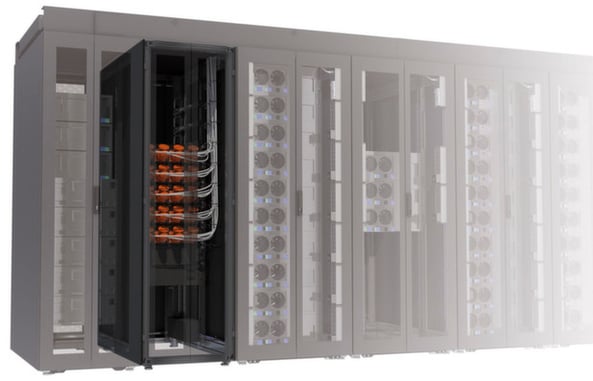
24

Today’s most innovative data centers are generally equipped with managed PDUs since their switching capabilities improve reliability. However, simply installing managed PDUs is not enough – an “unmanaged” managed PDU will actually reduce reliability.

So how do managed PDUs work? These advanced units offer a series of configurations which – if properly implemented – improve the availability of important services. The main features are Software Over Temperature Protection (SWOTP) and Software Over Current Protection (SWOCP), which are well described in the blog post “Considerations for a Highly Available Intelligent Rack PDU”.

It is also well-known, that managed PDUs can support commissioning or repairing workflows in data centers. The combination of well designed workflows and managed PDUs pushes the operational reliability to a higher level.

In high performance data centers, using clusters, another important point comes into play: clusters are complex hierarchical structures  of server farms, which are able to run high performance virtual machines and fully automated workflows.

As described here or here, such clusters are managed by centralized software together with server hardware.

Over the last couple of years cluster solutions have been developed following strong and challenging availability goals, in order to avoid any situation, which make physical servers struggle within the cluster. However, there would still be the risk of applications and processes generating  faults and errors and screwing-up the complete cluster, unless there was an automated control process – the good news is: there is.
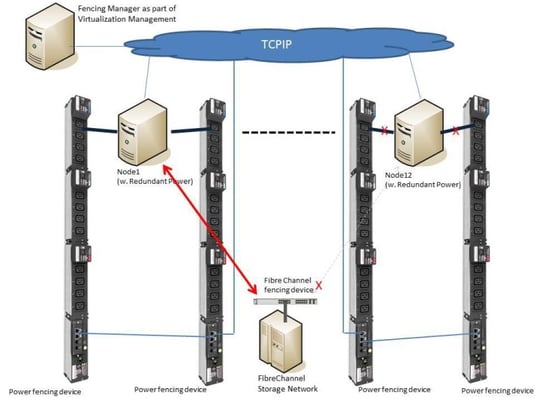
rack-blog-post-709x532

The process which controls those worst case scenarios is called fencing. Fencing automatically kicks out of the cluster any not working nodes or services in order to maintain the availability of the others.

Fencing has different levels, which are hopefully wisely managed. In a smooth scenario fencing will stop disturbing services, or re-organize storage access (Fibre channel switch fencing) to let the cluster proceed with its tasks.

Another power fencing option is also called “STONITH” (Shoot The Other Node In The Head) and allows the software to initiate an immediate shutdown (internal power fencing) of a node and/or a hard switch off (external power fencing).

The internal power fencing method uses IPMI and other service processer protocols, while the external power fencing uses any supported network protocol to switch of a PDU outlet.  It is recommended to use secured protocols only, such as SNMPv3. So managed PDUs as MPH2 or MPX do not only support a nice power balance, monitor power consumptions or support datacenter operations workflows – they also allow the fence software to react quickly for higher cluster reliability. So it’s not a secret that cluster solutions manufacturers – e.g. Red Hat with RHEL 6.7 and newer – openly support such managed rack PDUs.

For More Emerson Network Power Blogs, Click Here
Read More

Topics: Data Center, PUE, robust data center, Containment, efficient data center, DVL, electrical distribution, energy, Battery, Thermal Management, energy efficiency, 7x24, PDU

Breaking Down the Cost Implications of a Data Center Outage

by Marissa Donatone on 7/23/14 10:35 AM

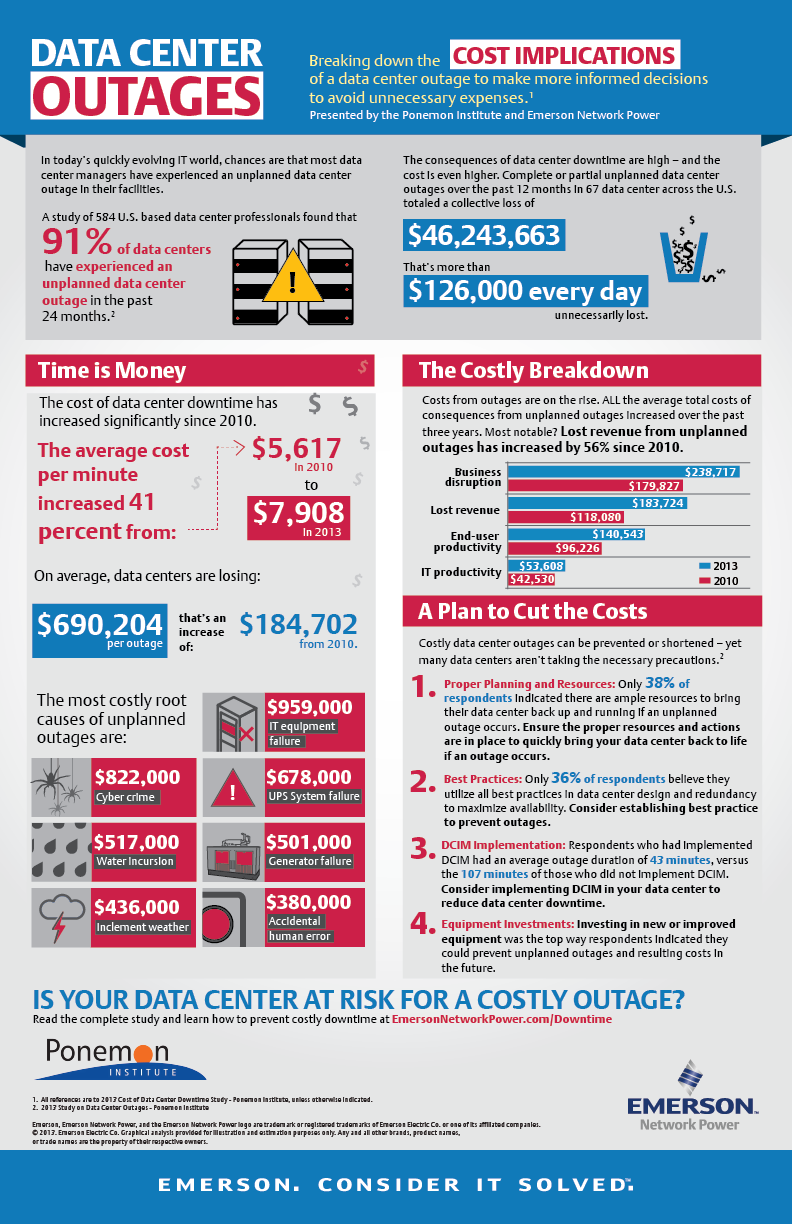
Emerson Network Power and the Ponemon Institute worked together to determine the full economic cost of unplanned data center outages. Below is a preview, for the full report CLICK HERE


The 2013 Cost of Data Center Outages is the only benchmark study that attempts to estimate the full costs associated with an unplanned data center outage. According to the study, the cost of a data center outage has increased since 2010.

The cost per square foot of data center outages now ranges from $45 to $95. Or, a minimum cost of $74,223 to a maximum of $1,734,433 per organization in our study. The overall average cost is $627,418 per incident.

This benchmark analysis focuses on representative samples of organizations in the U.S. that experienced at least one complete or partial unplanned data center outage during the past 12 months. The analysis was based on 67 independent data centers located in the United States. Following are the functional leaders within each organization who participated in the study:

  • Facility manager
  • Chief information officer
  • Data center management
  • Chief information security officer
  • IT compliance leader

Ponemon-infographic-cost-of-downtime-R11-13-final

Read More

Topics: downtime, data center infrastructure, efficient data center, data center outages

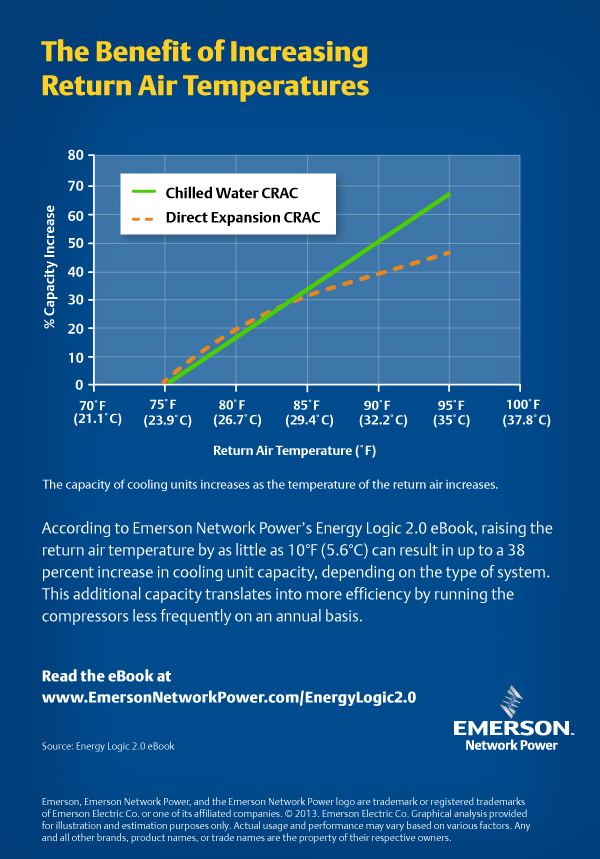
The Benefit of Increasing Return Air Temperatures

by Marissa Donatone on 8/20/13 8:44 AM

benefit of increasing return air temperatures resized 600
Read More

Topics: data center infrastructure, Data Center, data center design, data center infrastructure management, efficient data center, 7x24 exchange, critical air conditioning

Emerson Network Power- Integrate People, Process and Technology

by Marissa Donatone on 8/14/13 11:20 AM

Emerson Network Power Outlines How Best to Integrate People, Process and Technology to Transform Data Center Operations and Performance 

Columbus, Ohio [August 8, 2013] – With the data center at a critical stage in its evolution, Emerson Network Power, a business of Emerson (NYSE: EMR) and a global leader in maximizing availability, capacity and efficiency of critical infrastructure, today released a white paper that provides IT and data center managers with best practices for moving toward a holistic approach to data center management that rises above organizational, system-level silos while optimizing the interaction of people, process and technology to achieve true operational efficiency.

The white paper, titled “Integrating People, Process and Technology to Transform Data Center Operations and Performance,” takes a closer look at the constraints preventing organizations from optimizing data center performance and efficiency, and it provides a clear path for overcoming them through the better utilization of people, process and technology.

Read More

Read More

Topics: Emerson Network Power, data center infrastructure, Data Center, data center energy, efficient data center

The Server Closet Must Die...

by Mike Rinaldi on 6/20/13 12:46 PM

They are small, poorly managed, wasteful and high risk environments for a business’s IT systems and they’re lurking in a building near you. The server closet, it’s a danger to us all and it must be eradicated.

The server closet is a room set aside for IT gear, but not designed as a data center. Not even as a bad data center. They vary in size, but are generally between 100 SF and 2500 SF. The rooms usually have some extra AC assigned to them and maybe additional jury rigged power, but beyond that they are a large closet that IT gear has been force fit into. There are 10s of thousands of these server closets out in the wild. 


Read More

Topics: Emerson Network Power, data center infrastructure, Data Center, data center design, data center infrastructure management, robust data center, Containment, efficient data center

Subscribe to Our Blog

Recent Posts

Posts by Tag

see all